Author: UNEP
Published: 01 Jun,2026
Tags: Case Studies
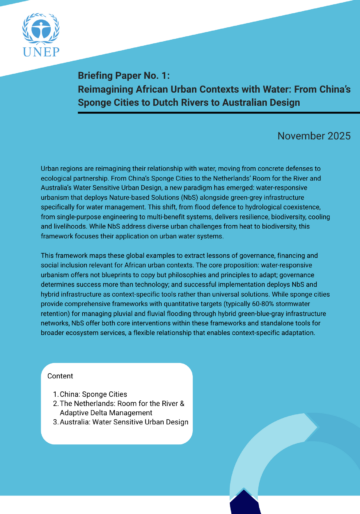
Briefing Paper No.1: Reimagining African Urban Contexts with Water: From China’s Sponge Cities to Dutch Rivers to Australian Design
Urban regions are reimagining their relationship with water, moving from concrete defenses to ecological partnership. From China’s Sponge Cities to the Netherlands’ Room for the River and Australia’s Water Sensitive Urban Design, a new paradigm has emerged: water-responsive urbanism that deploys Nature-based Solutions (NbS) alongside green-grey infrastructure specifically for water management. This shift, from flood defence to hydrological coexistence, from single purpose engineering to multi-benefit systems, delivers resilience, biodiversity, cooling and livelihoods. While NbS address diverse urban challenges from heat to biodiversity, this framework focuses their application on urban water systems. This framework maps these global examples to extract lessons of governance, financing and social inclusion relevant for African urban contexts. The core proposition: water-responsive urbanism offers not blueprints to copy but philosophies and principles to adapt; governance determines success more than technology; and successful implementation deploys NbS and hybrid infrastructure as context-specific tools rather than universal solutions. While sponge cities provide comprehensive frameworks with quantitative targets (typically 60-80% stormwater retention) for managing pluvial and fluvial flooding through hybrid green-blue-gray infrastructure networks, Nbs offer both core interventions within these frameworks and standalone tools for broader ecosystem services, a flexible relationship that enables context-specific adaptation.
Briefing Paper No.2: Water-responsive Urbanism in Africa
Across Sub-Saharan Africa, cities are beginning to reimagine their relationship with water. While China’s state-led Sponge City Program and the Netherlands’ Room for the River (RfR) offer instructive precedents, African pathways are unfolding differently, defined by community initiative, urban informality, modest scale, and adaptive innovation. This paper focuses on implemented and well-advanced projects that demonstrate how Nature-based Solutions (NbS) and Sponge City approaches are already being applied in practice across the continent. In Africa, water-responsive urbanism is emerging that integrates flood resilience with informal settlement upgrading and local livelihoods. From Mozambique’s Chiveve River Rehabilitation and Cape Town’s Liveable Urban Waterways, to Kenya’s Sponge Towns and Ghana’s Greater Accra Climate Resilient and Integrated Development, these projects demonstrate how Sponge City approaches and NbS can work within Africa’s socio-economic and ecological realities. Across the continent, demand is growing to scale up these proven interventions. Kigali, Rwanda, and Addis Ababa, Ethiopia, are advancing strategic frameworks for NbS integration; Dar es Salaam, Tanzania, is piloting urban greening for sustainable drainage; Accra, Ghana, is positioning itself as a hub for urban water resilience innovation; and in Nakuru, Kenya, the first phase of a Sponge City Project has been completed, with construction of physical infrastructure scheduled to begin in the near future.
Briefing Paper No.3: Global South Innovations in Water-responsive Urbanism
Three examples from the Global South, Medellín (Colombia), São Paulo (Brazil) and Bangladesh, offer critical insights into how water-responsive urbanism can emerge under complex social, economic and environmental constraints. Selected for their diversity and relevance to African contexts, these examples reveal how communities, municipalities, and national agencies can collaborate to deliver practical, inclusive and climate-resilient solutions. In Medellín, community-led green corridors link informal settlement upgrading with slope stabilization and flood mitigation. São Paulo illustrates the challenges of transitioning from engineered flood control to nature-based river restoration, balancing ecological goals with the realities of informality and resettlement. Bangladesh shows how local knowledge and adaptive design enable low-cost, community-centred responses to extreme flooding and unstable terrain. Together, these experiences highlight key lessons for African cities: the importance of participatory planning, institutional coordination, incremental implementation, and respect for local adaptive practices. They underscore that effective water-responsive urbanism depends as much on governance and social equity as on technical design.
Read MoreAuthor: PEDRR
Published: 20 May,2022
Tags: Policy
Read MoreAuthor: PEDRR
Published: 13 May,2022
Tags: Policy
Read MoreAuthor: PEDRR, FEBA
Published: 01 Nov,2021
Tags: Guidance , Policy
Read MoreAuthor: The Nature Conservancy
Published: 02 Feb,2021
Tags: Case Studies , Coastal , EbA , Guidance
The Blue Guide to Coastal Resilience provides DRR planners with step-by-step guidance for integrating various nature-based solutions (NbS) into DRR planning in coastal areas to support climate vulnerable communities to adapt to climate change. Through analytical tools and processes, the guide helps DRR planners assess climate risks, conditions for NbS to work, as well as the costs of using them. Its approach is highly participatory, requiring planners to work closely with local stakeholders, including communities and government decision makers, to ensure support and sustainability of NbS. The guide includes inspiring case studies that demonstrate how NbS have not only reduced impacts of climate disasters, but simultaneously increased food security, strengthened the social fabric of a community and delivered economic benefits. The Blue Guide is for DRR planners ready to shift from short to long term planning and support livelihoods in the context of climate change. An interactive version of the guide will be available on www.natureprotects.org.
Read MoreAuthor: UNEP
Published: 09 Apr,2020
Tags: Science
This is a 2-pager that explains the first global maps to identify suitable ecosystem areas for reducing disaster risks. The maps are being developed by UNEP with the support of the European Union as part of the ‘Up-scaling community resilience through ecosystem-based disaster risk reduction’ project.
Read MoreAuthor: PEDRR/ UNEP
Published: 08 Apr,2020
This 2-pager provides an overview of Ecosystem-based Disaster Risk Reduction (Eco-DRR) and the benefits of implementing ecosystem-based solutions.
Read MoreAuthor: PEDRR
Published: 08 Apr,2020
This 2-pager gives an overview of Partnership for Environment and Disaster Risk Reduction (PEDRR) and our activities.
Read MoreAuthor: UNEP and PfR
Published: 08 Apr,2020
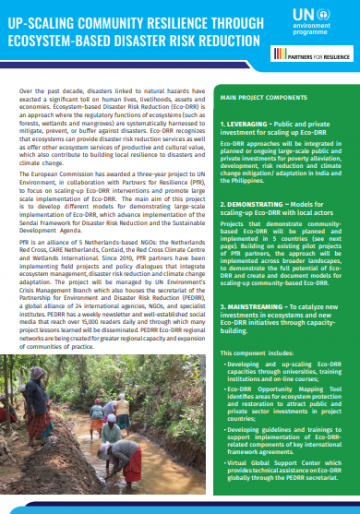
This 2-pager provides an overview of the ‘Up-scaling community resilience through ecosystem-based disaster risk reduction’ project. The project in being implemented by UNEP and Partners for Resilience (PfR) with the support of the European Union.
Read MoreAuthor: Nicole-Karolina Rokicki
Published: 20 Jan,2020
Gender issues are a sensitive topic in all cultures; however, gender is a highly significant factor to take into account to assess people’s vulnerability against disasters. Gender differences are pivotal in understanding unequal access to natural resources and the impacts of empowerment towards sustainable outcomes. This thesis elucidates the nexus of gender, ecosystem management and disaster risk reduction, providing recommendations for gender-responsive actions to support the implementation of ecosystem-based disaster risk reduction (Eco-DRR) interventions. This study examines the current state of existing literature addressing the proposed nexus with a systematic literature review. The review is complemented by interviews with experts from the EcoDRR field, evaluating the perception of gender issues in practice and discussed through a comparison of pilot projects by UNEP in Afghanistan and Haiti. Results from the first two methods revealed six main components that are defined to conduct gender responsive actions in Eco-DRR. They determine people’s engagement for disaster risk strategies and serve as guiding tools for the application of activities to overcome gender biases. These components are exemplified with the suggested case studies to demonstrate the context-specific integration of gender considerations. Through the analysis of scientific research, expert interviews as well as case studies this thesis brings science, policy and implementation perspectives together and provides a holistic understanding of the linkages in the nexus of gender, ecosystems and disaster risk reduction.
Read MoreAuthor: European Investment Bank.
Published: 09 Dec,2019
Tags: Finance
Read MoreAuthor: UNEP
Published: 01 Oct,2019
This book explains the importance of ecosystems and their management for DRR and CCA and provides guidance to plan and implement ecosystem-based disaster risk reduction and climate change adaptation (Eco-DRR/EbA).
Read MoreAuthor: The Nature Conservancy
Published: 01 Jan,2019
Tags: Finance , Reports
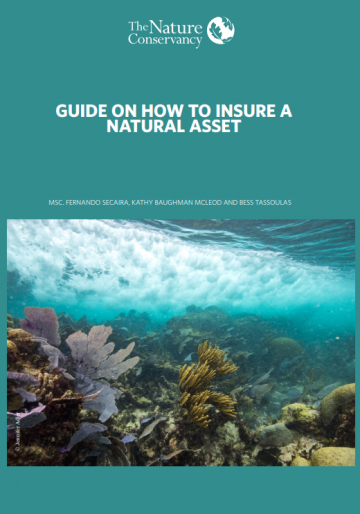
“Nature sustains livelihoods and economies, reduces risk to people and infrastructure and help us to adapt to climate
change (Renaud et al., 2013; Ferrario et al., 2014; Spalding et al., 2014a, b). Nature and the ecosystem services provided
constitute an asset for people and the economy. However, nature is also at risk and can suffer severe damages from
hurricanes, fires, droughts, oil spills and other natural and anthropogenic events. Sometimes damages can be reversed
and repaired, bringing back the ecosystem services that nature provides, but immediate funds and response are required.
Transferring the risk of restoring the damages to nature is a sound financial strategy for the beneficiaries and entities
responsible for the natural asset.
This guide describes the phases and steps to design an insurance for natural assets at risk”
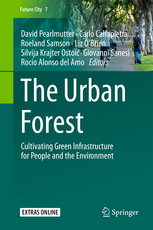
Author: Pearlmutter, D., Calfapietra, C., Samson, R., O'Brien, L., Krajter Ostoić, S., Sanesi, G., Alonso del Amo, R. (eds.)
Published: 09 Dec,2017
Tags: Urban
This publication provides the first comprehensive catalog of tree species that is cross-correlated with the ecosystem services they provide in different regions of Europe.
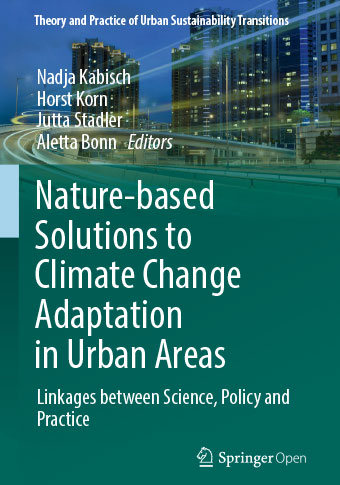
Read MoreAuthor: Kabisch N., Horst K., Stadler J., Bonn A. (edis)
Published: 07 Dec,2017
Tags: Policy , Science , Urban
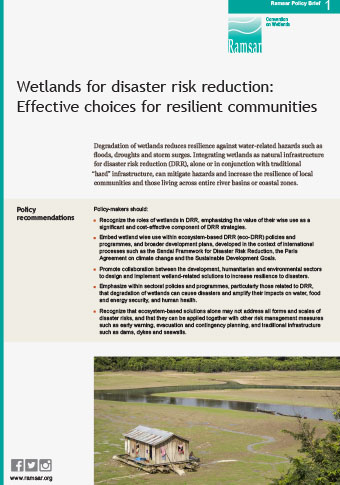
Read MoreAuthor: Kumar, R., Tol, S., McInnes, R. J., Everard, M. and Kulindwa, A.A.
Published: 10 Jul,2017
Tags: Policy , Wetlands
Read MoreAuthor: Monty, F., Murti, R. and Furuta, N., IUCN
Published: 10 Dec,2016
Tags: Policy , Science
The International Union for the Conservation of Nature (IUCN) makes the case for implementing integrated approaches that benefit both biodiversity, conservation and Disaster Risk Reduction. The publication builds on regional experiences, highlighting opportunities and entry points to scale-up integrated approaches for Eco-DRR.
Read MoreAuthor: Renaud, F. G., Sudmeier-Rieux, K., Estrella, M., & Nehren, U.
Published: 16 Nov,2016
Tags: Policy , Science
This publication by PEDRR compiles recent developments globally in the field of ecosystem-based disaster risk reduction and climate change adaptation.
Read MoreAuthor: UNEP (2016a)
Published: 10 Sep,2016
Tags: Coastal , EbA
Read MoreAuthor: UNEP (2016b).
Published: 10 Aug,2016
Tags: Case Studies , Coastal
Read MoreAuthor: UNEP (2016c).
Published: 08 Aug,2016
Tags: Case Studies , Coastal
Read MoreAuthor: UNEP (2016e).
Published: 03 Aug,2016
Tags: Case Studies , Drylands
Read MoreAuthor: PEDRR
Published: 20 May,2016
Tags: Policy
This policy brief reflects PEDRR’s analysis of the SFDRR from an Eco-DRR/CCA perspective but recognizes the important linkages across the 2030 Sustainable Development Agenda. This brief examines the role of ecosystems and environment in the SFDRR and highlights opportunities for implementing integrated ecosystem management and risk reduction strategies in countries and communities. It outlines a Road map for advancing implementation of the SFDRR through Eco-DRR/CCA and reflects on the scope for promoting Eco-DRR/CCA as an integrated strategy that delivers across the 2030 Sustainable Development Agenda.
Read MoreAuthor: UNEP (2016d).
Published: 05 Aug,2015
Tags: Case Studies , IWRM
Read MoreAuthor: Renaud, F.G., Sudmeier-Rieux, K. and Estrella, M., (eds)
Published: 10 Nov,2013
Tags: Policy , Science
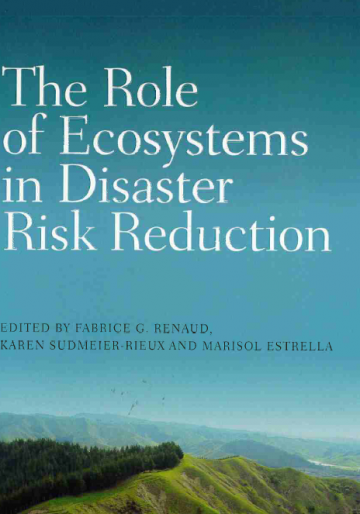
Edited by the United Nations University Institute for Environment and Human Security (UNU-EHS), IUCN’s Commission on Ecosystem Management and the United Nations Environment Programme, The Role of Ecosystems in Disaster Risk Reduction is one of the first books to compile latest knowledge and evidence on the links between healthy ecosystems and resilience to disasters. Contributions by 58 professionals from science and practice communities around the world are structured around 17 chapters describing state-of-the-art knowledge and perspectives in the fields of ecosystem management, disaster risk reduction and climate change adaptation.
Read MoreAuthor: Partnership for Environment and Disaster Risk Reduction (PEDRR)
Published: 10 Dec,2011
Tags: Policy , Urban
Read More