- Zoom
- 2:30 pm -
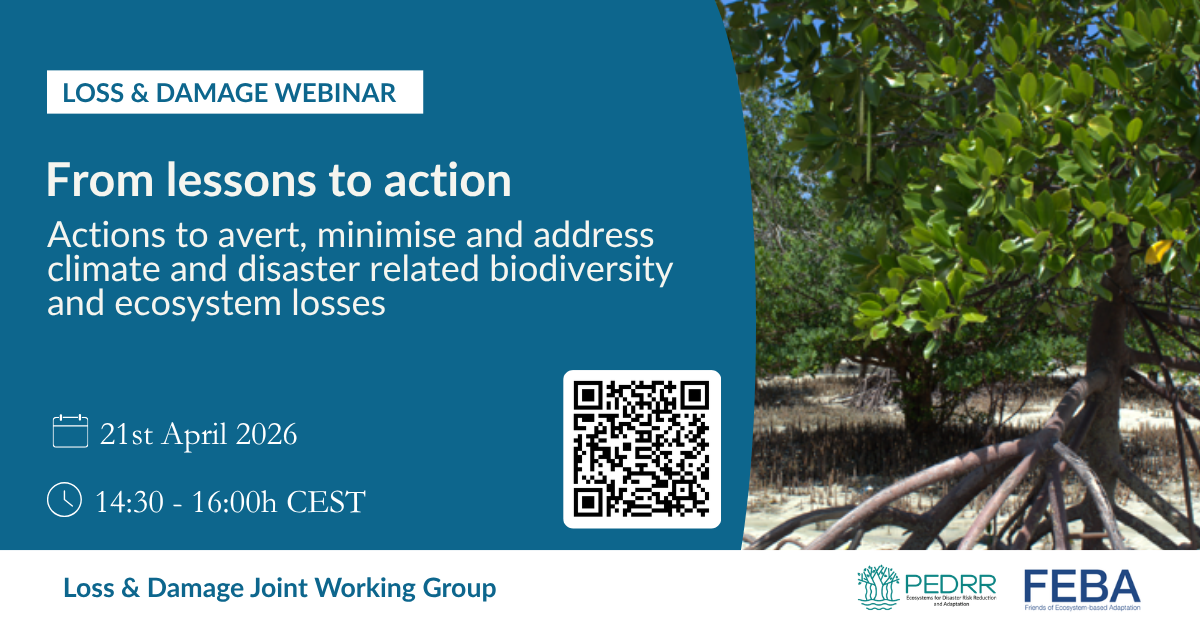
Following the February launch of the FRAME-ECO framework, this session moved from the “what” to the “how.” Hosted by the PEDRR-FEBA Joint Working Group on Loss and Damage, the webinar brought together participants from around the world to bridge the gap between high-level policy and the front lines of ecosystem recovery.

Photo: FEBA/PEDRR – Julia Rocha Romero, Rose Washington, Dr. Elisa Calliari and Dr. Neil Aldrin Mallari
The Mission: Bridging the Implementation Gap
While frameworks like FRAME-ECO have laid the groundwork for identifying and tracking biodiversity- and ecosystem-related losses, a persistent gap remains: ecosystem-based approaches are still underrepresented in disaster policy.
Moderator Rose Washington, Programme Officer, IUCN, opened the session by noting that while progress has been made in monitoring non-economic losses, the key challenge lies in implementation. The goal of the session was to explore how action and global policy frameworks can reinforce one another to protect the most vulnerable.
Ms. Washington then introduced a panel of three expert speakers, bringing together practitioners working at the intersection of policy, research, and on-the-ground implementation to share their perspectives on these challenges.
The Journey: From Global Architecture to Local Reality
The discussion followed a clear trajectory: from global policy frameworks, to field-based evidence, and finally to how international systems can better protect vulnerable communities.
1. Global Policy: Embedding Nature in the Fund
Dr. Elisa Calliari, Co-Chair of the WIM ExCom, highlighted that while progress has been made in “knowledge generation,” the next step is operationalisation. She noted:
“The ExCom, Santiago Network, and Fund for Responding to Loss and Damage provide a pathway from global frameworks to local action. The key challenge is ensuring ecosystem-based approaches are systematically embedded in technical assistance and financial support for the most vulnerable communities.”
● The pathways: The Santiago Network and the Fund for Responding to Loss and Damage are key mechanisms for translating frameworks into action.
● The gap: A deeper understanding is needed of the limits of Nature-based Solutions (NbS) in post-disaster contexts—when and where ecosystems can provide added value during recovery.
● Key message: Ecosystem-based approaches must be systematically embedded in technical assistance to ensure they reach those most reliant on nature.

2. Frontline Science: The GARF Framework in the Philippines
Dr. Neil Aldrin Mallari, Center for Conservation Innovations, brought 30 years of experience to the table, highlighting why biodiversity is often overlooked during early disaster recovery:
“Global experience shows that early disaster recovery often neglects biodiversity and ecosystems, mainly due to a lack of standard assessment methods.”
● The solution: The Green Assessment and Recovery Framework (GARF), a science-based tool bridging environmental protection and humanitarian recovery.
● The impact: In the Philippines, GARF is helping shift traditional Disaster Risk Reduction (DRR) approaches toward Eco-DRR, integrating species and habitat protection into post-typhoon recovery.
● The hurdles: Scaling GARF requires overcoming socio-cultural barriers and ensuring participatory decision-making that includes women and Indigenous peoples.
3. The Evidence Bridge: Breaking Institutional Silos
Julia Rocha Romero, UNEP Copenhagen Climate Centre, challenged the framing of NbS as solely adaptation tools:
“Nature-based solutions are often framed narrowly as adaptation. The opportunity gap that policy makers and practitioners do not often seize is how their role spans the entire continuum—from risk reduction to Loss & Damage.”
● The continuum: NbS spans the full spectrum, from risk reduction to addressing permanent loss and damage.
● The “invisible” loss: What is visible to local communities is often invisible to policymakers—highlighting the need for research institutions to translate local realities into actionable, policy-relevant data.
● New tool alert: A Loss and Damage cost-assessment tool, to be released in June 2026, will provide sectoral insights and quantify the costs of inaction, with pilot applications in Zambia and Mauritius.

Looking Ahead: Scaling Ecosystem-Based Loss and Damage Responses
The session concluded with a clear message: moving from lessons to action requires coordinated efforts across all levels.
Global frameworks must be supported by strong national systems and grounded in local realities. Mechanisms such as the Santiago Network and the Fund for Responding to Loss and Damage offer critical opportunities to channel technical and financial support directly to vulnerable communities—ensuring that ecosystem-based approaches are both accessible and actionable.
Addressing biodiversity and ecosystem losses is central to effective climate action. By strengthening data systems, building institutional capacity, and advancing ecosystem-based approaches, countries can move beyond incremental adaptation toward more comprehensive and resilient responses to loss and damage.
Synthesis: Looking Toward 2026 and Beyond
The session closed by addressing a key challenge: finance.
While tools such as GARF and FRAME-ECO provide the data and evidence base, integrating these approaches into national disaster planning and international financial flows remains a critical hurdle.
As 2026 marks a pivotal year for operationalising global funds, the message was clear: “Every Loss Matters. Every Action Counts”.
Missed the Session?
You can watch the full recording here.