- Online
As climate change intensifies disasters worldwide, biodiversity and ecosystem losses remain largely invisible in official assessments. On February 24th, the joint FEBA-PEDRR Working Group on Loss and Damage launched its 2026 webinar series, “Every Loss Matters”, with a session focused on closing this critical gap.

The opening session, “Accelerating the assessment of climate and disaster-related biodiversity and ecosystem losses: Towards applying FRAME-ECO,” introduced a practical path forward for countries to identify and track the ecosystem losses often overlooked in disaster reporting and recovery processes. The webinar highlighted the urgent need for improved data, standardised methodologies, and stronger integration of environmental losses into policy and recovery planning. The session brought together 140 participants, reflecting strong interest in advancing approaches to better assess and address ecosystem-related loss and damage.
The Gap in Disaster Reporting
Moderator Chawanangwa Nyirenda, Loss and Damage Specialist at the UN Environment Programme (UNEP) and co-chair of the FEBA-PEDRR Loss and Damage Working Group, opened the session by highlighting a persistent gap in disaster reporting, where environmental losses remain under-represented in Post-Disaster Needs Assessments despite their critical impacts on livelihoods and resilience.
The working group was established to bridge these gaps by strengthening the understanding of ecosystem-related losses and advancing the role of Nature-based Solutions (NbS) and Ecosystem-based Adaptation (EbA) in addressing loss and damage.
Introducing FRAME-ECO: A New Standardised Framework

Dr. Yvonne Walz, Head of Environmental Vulnerability and Ecosystem Services at the United Nations University Institute for Environment and Human Security (UNU-EHS) and Working Group Co-Chair, presented the FRAME-ECO framework and its development. The methodology emerged from extensive analysis of global case studies examining how climate change and disasters impact ecosystems, biodiversity, and the human systems that depend on them.
FRAME-ECO responds to the absence of a standardised global approach to monitoring ecosystem losses associated with climate and disaster events. The framework is structured around four key components: the hazard context, ecosystem and biodiversity context, loss assessment, and use cases for decision-making. Together, these components enable countries to compare ecosystem conditions, extent, services, and diverse values of nature before and after hazard events, identify environmental losses, and better integrate ecosystem considerations into climate and disaster risk governance. Dr. Walz emphasised that ecosystem loss cannot be understood in isolation from society. Damage to ecosystems often cascades into broader impacts on livelihoods, culture, health, and security, illustrating the interconnected nature of socio-ecological systems. By capturing these interdependencies, FRAME-ECO aims to make environmental losses more visible within policy processes and national reporting systems.
Insights from the Field: Putting Theory into Practice
The webinar’s panel discussion explored how the framework can be operationalised in real-world contexts. Global experts in loss and damage shared insights on integrating ecosystem loss assessments into policy and planning.

Dr. Noralene “Lenee” Uy from the Philippines’ Department of Environment and Natural Resources described the country’s experience implementing the Green Assessment and Recovery Framework (GARF) following Typhoon Rai in 2021. The initiative brought together existing data, including land-cover maps, biodiversity-monitoring systems, and hazard records, to establish practical baselines for assessing environmental damage. She emphasised that rather than waiting for ideal datasets, governments must rely on the best available information, combining social and ecological data to assess ecosystem losses and inform recovery planning.
Dr. Mani Nepal from the International Centre for Integrated Mountain Development (ICIMOD) highlighted the complexity of applying disaster frameworks in fragile mountain ecosystems across the Hindu Kush Himalaya region. The region’s ecological diversity and rapidly changing landscapes make establishing baseline data particularly challenging. However, Dr. Nepal noted that structured assessment tools such as FRAME-ECO and ICIMOD’s Six Step Protocol —which includes mapping, data monitoring, understanding social and governance systems, identifying recharge areas, implementing recharge measures and governance protocols, and monitoring impact—can complement each other in evaluating environmental change and informing adaptation strategies. While FRAME-ECO integrates ecosystem services into disaster risk reduction, ICIMOD’s Six Step Protocol standardises data collection across transboundary terrains.
Le-Anne Roper from the United Nations Office for Disaster Risk Reduction (UNDRR) discussed the Disaster and Hazardous Events Losses and Damages Tracking and Analysis System (Delta Resilience), which supports governments in standardising disaster data and linking hazard information with exposure, vulnerability, and impacts. The system supports standardised data collection and enables governments to track both sudden-onset disasters and slow-onset climate impacts while integrating quantitative and qualitative data sources, including community observations and citizen science. Integrating methodologies such as FRAME-ECO into systems like Delta Resilience could help ensure that biodiversity and ecosystem losses are systematically documented and incorporated into national and global disaster risk assessments.
The Road Ahead: Beyond Numbers
During the Q&A session, panellists underscored the importance of capturing non-economic losses, including cultural heritage, traditional livelihoods, and Indigenous knowledge systems in disaster assessment. These dimensions are often difficult to quantify but remain central to understanding the full scope of climate impacts on ecosystems and communities. While FRAME-ECO provides the structure, the consensus was clear: success requires better baseline data, stronger institutional coordination, and significant capacity-building.
The Bottom Line
The webinar concluded with a clear message: improving the assessment of biodiversity and ecosystem losses is essential for effective climate adaptation and disaster risk reduction. By strengthening monitoring systems, integrating ecosystem data into disaster assessments, and aligning scientific methodologies with policy needs, initiatives like FRAME-ECO can help ensure that environmental losses are recognised and addressed within climate and disaster decision-making processes.
Stay Connected
If you weren’t able to join us, you can view the full session video here.
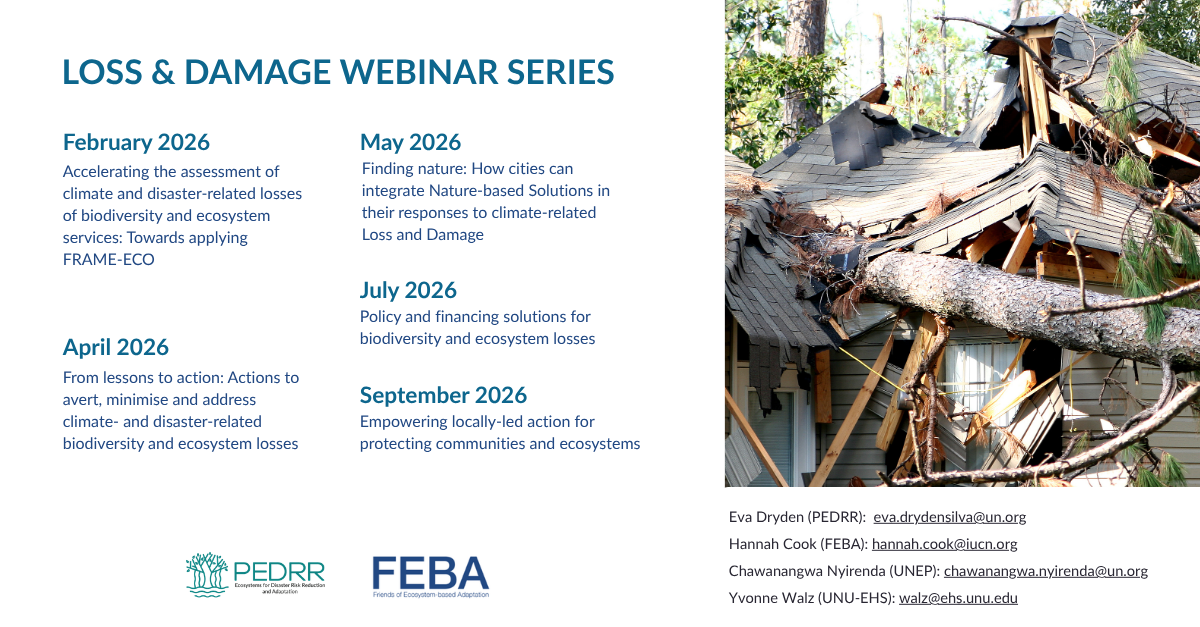
This session was just the first instalment of our loss and damage webinar series. Our upcoming webinars will dive deeper into:
- Practical ecosystem restoration strategies.
- Policy and financing solutions.
- Community-led action.
Stay tuned for our upcoming webinars! Follow our updates to ensure you don’t miss the next session in this critical series.